


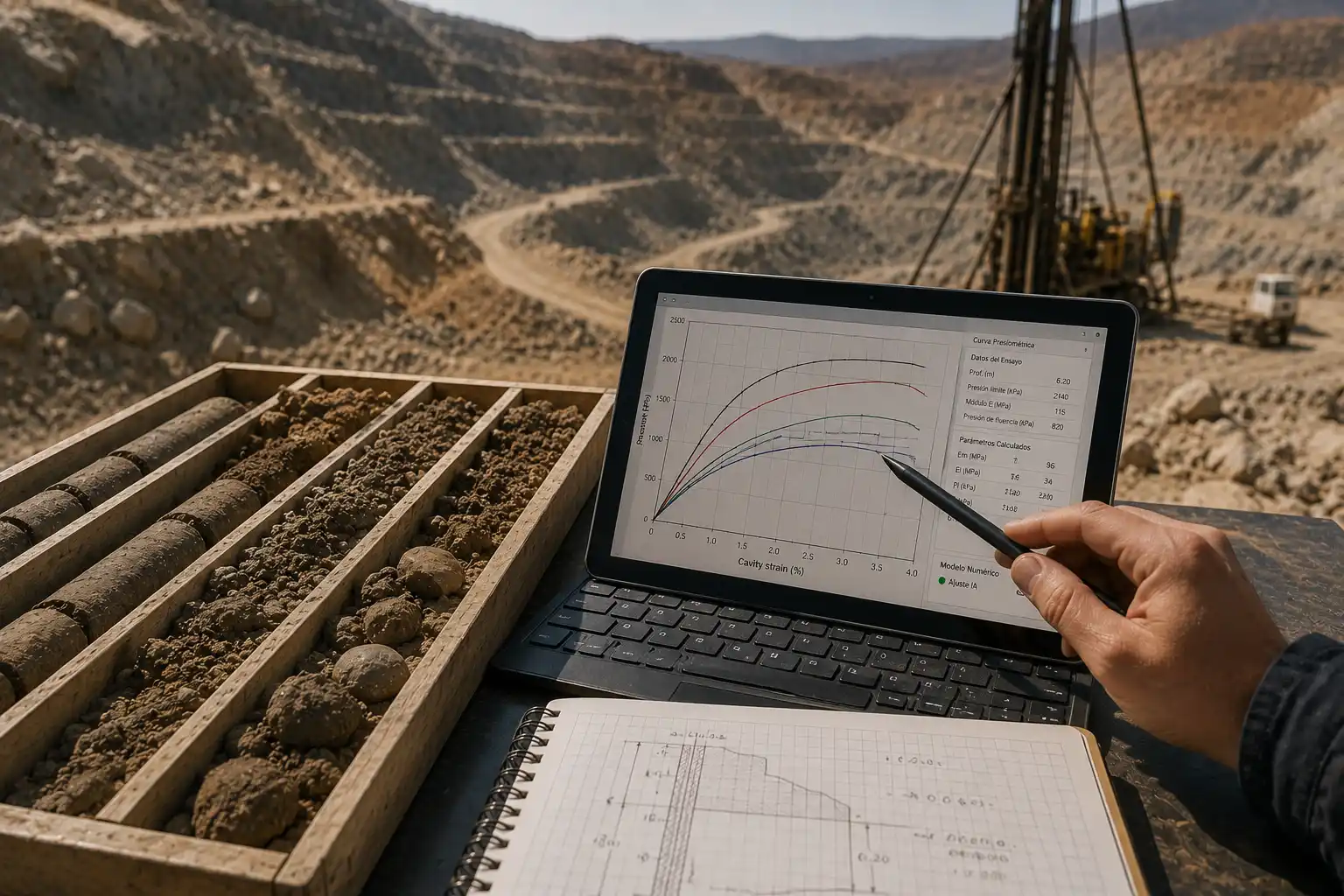
One of the main challenges in mining geotechnics is the variability of ground parameters. Even with well-executed site investigations, the natural heterogeneity of geological materials and the limitations of conventional testing methods can introduce uncertainty into the interpretation of geotechnical data, ultimately affecting design decisions. In this context, the challenge is not simply to collect more data, but to interpret it more effectively.
Pressuremeter testing provides a robust foundation for addressing this challenge by delivering geotechnical parameters directly in situ under controlled loading conditions. In mining applications, the pressuremeter has proven particularly effective across a wide range of materials, from soft tailings to coarse-grained soils, mine waste, and weathered rock formations that are often difficult to characterize using conventional investigation techniques. These materials present a particular challenge because traditional tests frequently fail to accurately capture their deformation behavior.
However, the true value of pressuremeter data emerges when it is integrated into a comprehensive interpretation process. Numerical modeling transforms measured parameters into predicted ground behavior, allowing engineers to evaluate different scenarios, validate design assumptions, and assess the response of the ground under various operating conditions. Rather than serving as a purely theoretical representation, the numerical model becomes a practical engineering tool for understanding and anticipating real ground performance.
In recent years, the incorporation of artificial intelligence has further enhanced this process. Through iterative simulations, AI can evaluate thousands of combinations of geotechnical properties to identify those that best reproduce the pressuremeter response curve, significantly reducing the time and effort required for manual interpretation. The objective is not to replace engineering judgment, but to complement it with a powerful analytical tool capable of validating results, reducing the variability of design parameters, and improving the efficiency of geotechnical characterization.
Experience from mining projects demonstrates that the greatest value does not lie in any single technology, but in the integration of high-quality site investigation, numerical modeling, and advanced data analysis. When reliable field data are combined with sound engineering interpretation, it becomes possible to reduce uncertainty, optimize designs, and support more informed engineering decisions in complex geological environments.