


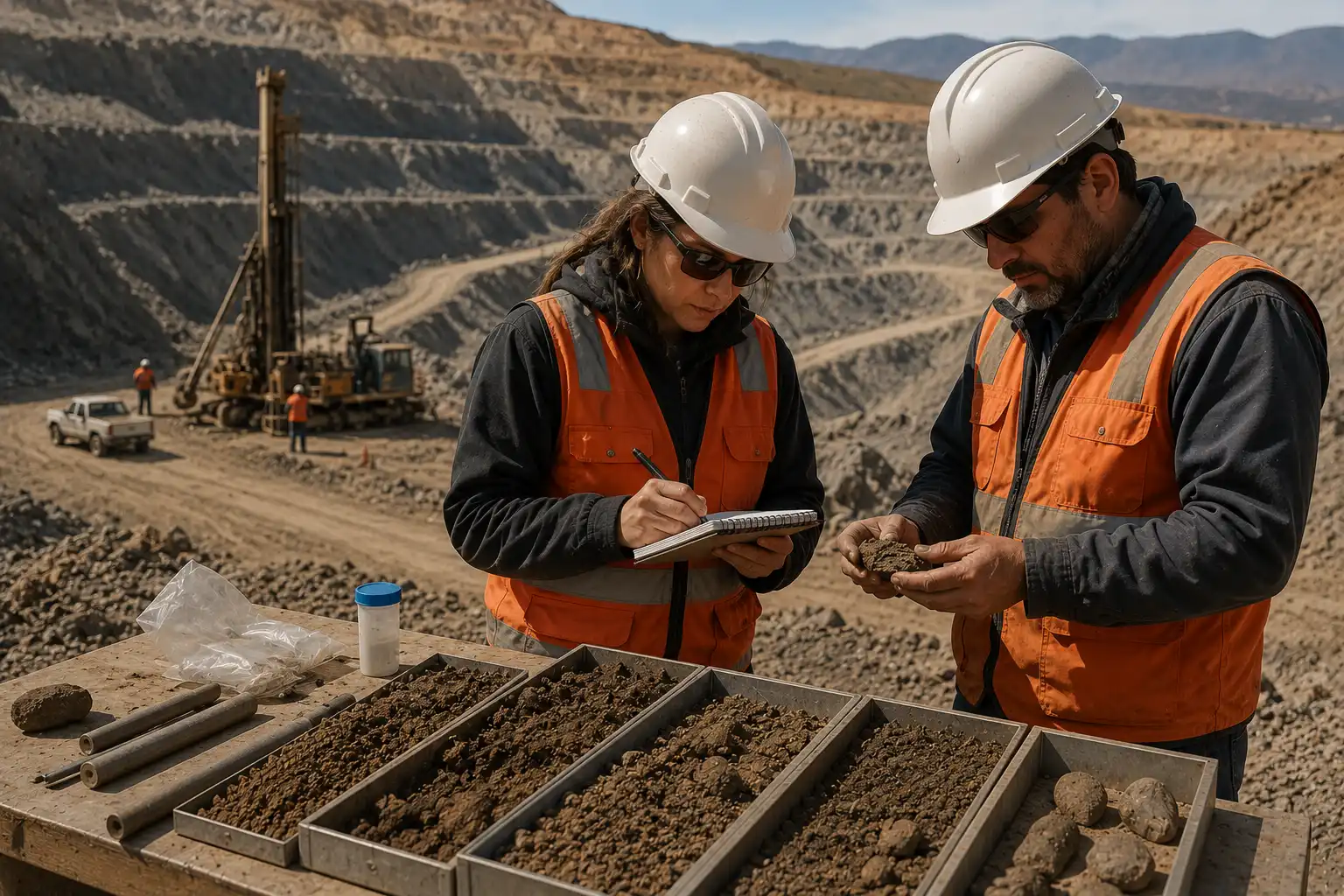
Mining projects in Chile often face challenging ground conditions characterized by coarse-grained, hard, and highly variable materials that are not always adequately represented by traditional empirical correlations. Bridging the gap between theoretical assumptions and actual ground conditions requires high-quality geotechnical data capable of reducing uncertainty while supporting safe and efficient engineering design.
A common challenge arises in dense granular soils and hard ground deposits, which are frequently encountered in mining environments. Under these conditions, conventional site investigation methods such as the Standard Penetration Test (SPT), Cone Penetration Test (CPT), and even certain geophysical techniques may reach refusal or produce parameters that do not accurately represent the true engineering behavior of the ground.
When this occurs, design parameters are often derived from empirical correlations, published references, or conservative assumptions to compensate for the uncertainty. While this approach allows projects to move forward, it may also lead to two undesirable outcomes: overdesigned solutions with unnecessary construction costs, or lower-than-expected safety margins due to ground parameters that do not accurately reflect actual field conditions.
In this context, in situ testing plays a fundamental role by directly measuring the response of the ground in its natural state.
Among these techniques, pressuremeter testing is particularly valuable in coarse-grained and heterogeneous soils. By applying controlled radial pressure to the surrounding ground and measuring its deformation, the pressuremeter provides representative stiffness, strength, and deformation properties while accounting for factors such as particle interaction, depositional processes, and the in situ stress history.
When geotechnical parameters accurately represent the ground conditions, numerical models become more reliable and engineering decisions can be made with greater confidence. In mining, designing with reliable field data is not simply a methodological refinement—it is a fundamental requirement for reducing uncertainty, optimizing designs, and improving the overall performance of geotechnical works.