


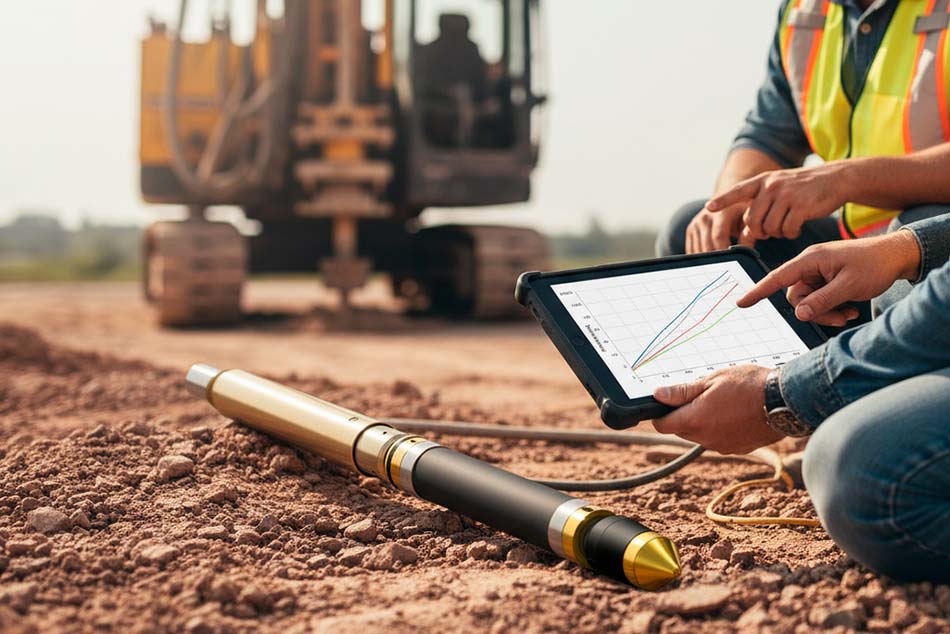
In geotechnical engineering, the quality of subsurface information largely determines the safety and efficiency of any project. However, in a country like Chile—with hard soils, weathered rock, and a geography shaped by the Andes and high seismicity—traditional investigation methods such as the Standard Penetration Test (SPT), Cone Penetration Test (CPT), and laboratory testing do not always provide representative results.
In this context, high-resolution pressuremeter testing offers a reliable alternative for characterizing complex ground conditions and designing safe, efficient foundations tailored to local geological conditions.
What Makes a High-Resolution Pressuremeter Different?
Pressuremeters are not new to geotechnical engineering. The most widely used instrument worldwide has been the Ménard pressuremeter, which has seen extensive application across Europe. However, this device provides averaged results and relies on empirical correlations, which can limit its applicability and accuracy in ground conditions such as those commonly encountered in Chile.
High-resolution pressuremeters represent a significant advancement because they:
- Mediante strain gauges registran deformaciones hasta 1Use strain gauges to measure deformation with up to 1,400 times greater resolution than a conventional pressuremeter (Martínez, 2023).
- Provide in situ stress–strain curves without relying on empirical tables or external correlations.
- Mobilize a large volume of ground, making them suitable for testing coarse-grained soils, gravels, cobbles, and hard soils.
- Provide geotechnical parameters for advanced constitutive soil models and allow the determination of K₀ (coefficient of earth pressure at rest).
Applications in Chile for Complex Ground Conditions and Demanding Projects
For large-scale or strategically important projects, particularly in the industrial and mining sectors, obtaining reliable deformation parameters is essential to ensure structural performance and long-term safety.
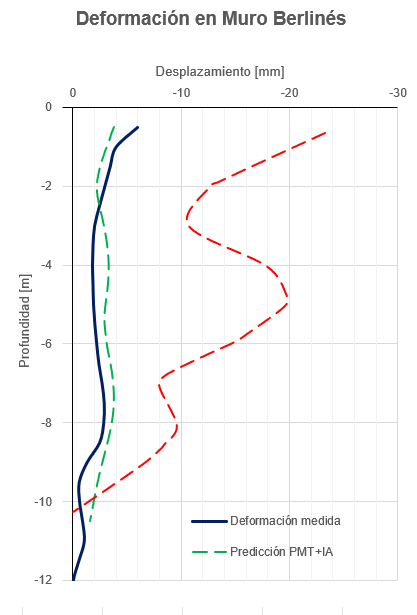
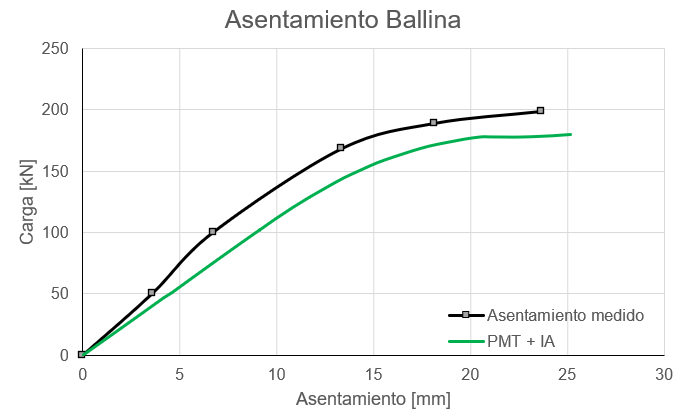
Pangea Geotecnia's high-resolution pressuremeters have proven particularly valuable in the design of retaining walls and foundations, providing ground parameters that more accurately represent field conditions. When incorporated into finite element models, these data help reduce uncertainty in the prediction of settlements and deformations.
**References:**
1 Martínez, R. (September 2023). Webinar I: The Use of Artificial Intelligence and Pressuremeters for Optimising Geotechnical Design
2 *An Optimisation Strategy for Evaluating Modified Cam Clay Parameters Using Self-Boring Pressuremeter Test Data*