


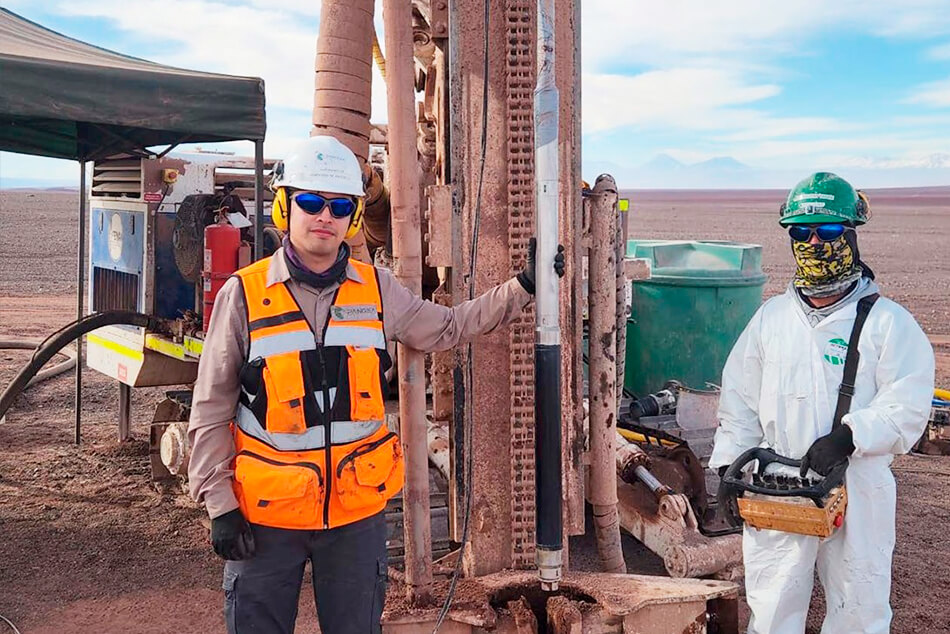
In geotechnical engineering, the quality of the initial data often determines the success or failure of a project. In Chile, where the geology is characterized by hard soils, high seismicity, and one of the world's steepest energy gradients, traditional site investigation methods such as the Standard Penetration Test (SPT) and the Cone Penetration Test (CPT) do not always provide reliable results. This is because many Chilean soils are coarse-grained, granular, and difficult to sample without disturbance.
In this context, high-resolution pressuremeters provide a way to directly measure fundamental soil parameters without relying on empirical correlations, extending the capabilities of conventional investigation methods.
Why Use Pressuremeters in Chile?
Chile presents unique geographical and geotechnical conditions:
- Steep topography: More than 5,000 meters of elevation change within only 180 km.
- Coarse and hard soils: A limited presence of the clays and silts typically found in low-energy depositional environments.
- High seismicity: Designs require accurate ground parameters to avoid unnecessary costs and structural failures.
Under these conditions, traditional methods may underestimate or overestimate key geotechnical parameters, affecting both safety and project costs. As a pre-bored testing device that mobilizes a large volume of soil, the pressuremeter can be used even in gravels and very dense soils, providing stress–strain curves that are representative of the ground's actual behavior.
The Advantage of High-Resolution Pressuremeters
Unlike the conventional Ménard pressuremeter, which averages deformation measurements and relies on empirical correlation charts, high-resolution pressuremeters:
- Measure deformation with up to 400 times greater precision using high-sensitivity internal sensors.
- Enable a fundamental analysis of soil response without relying on correlations calibrated for other geological environments.
- Provide parameters such as K₀ (coefficient of earth pressure at rest) and the natural state of the soil, both of which are essential for modeling the behavior of slopes, retaining walls, and foundations.
Overcoming Historical Interpretation Challenges
One of the main challenges in pressuremeter testing has always been the interpretation of the results. Traditionally, solving the differential equations that describe the behavior of the soil around the probe was a complex process that could require weeks of work.
Today, our methodology (patent pending) has enabled us to validate geotechnical parameters through comparisons with field instrumentation, including inclinometer measurements and observed settlements, achieve prediction errors of less than 1 mm for ground deformations, and apply the method to complex soils, including materials that barely qualify as "soil" under conventional classification systems.
Our high-resolution pressuremeters make it possible to optimize the design of retaining walls and piles by providing parameters obtained directly from the ground and representative of its actual behavior. These parameters can be incorporated into more accurate numerical models, reducing uncertainty in the prediction of settlements and deformations. They are also valuable in the assessment of dams and tailings storage facilities, where understanding the natural state and strength of the material is essential for evaluating the potential for static and seismic liquefaction.
The use of pressuremeters represents not only a technological advancement but also a different approach to ground characterization. In demanding geological environments such as those found in Chile, access to detailed and reliable ground information makes it possible to develop engineering solutions that better reflect actual subsurface conditions, supporting safer and more sustainable designs.